



The Interesting Link Between Kelp Biostimulants and Wine Compounds
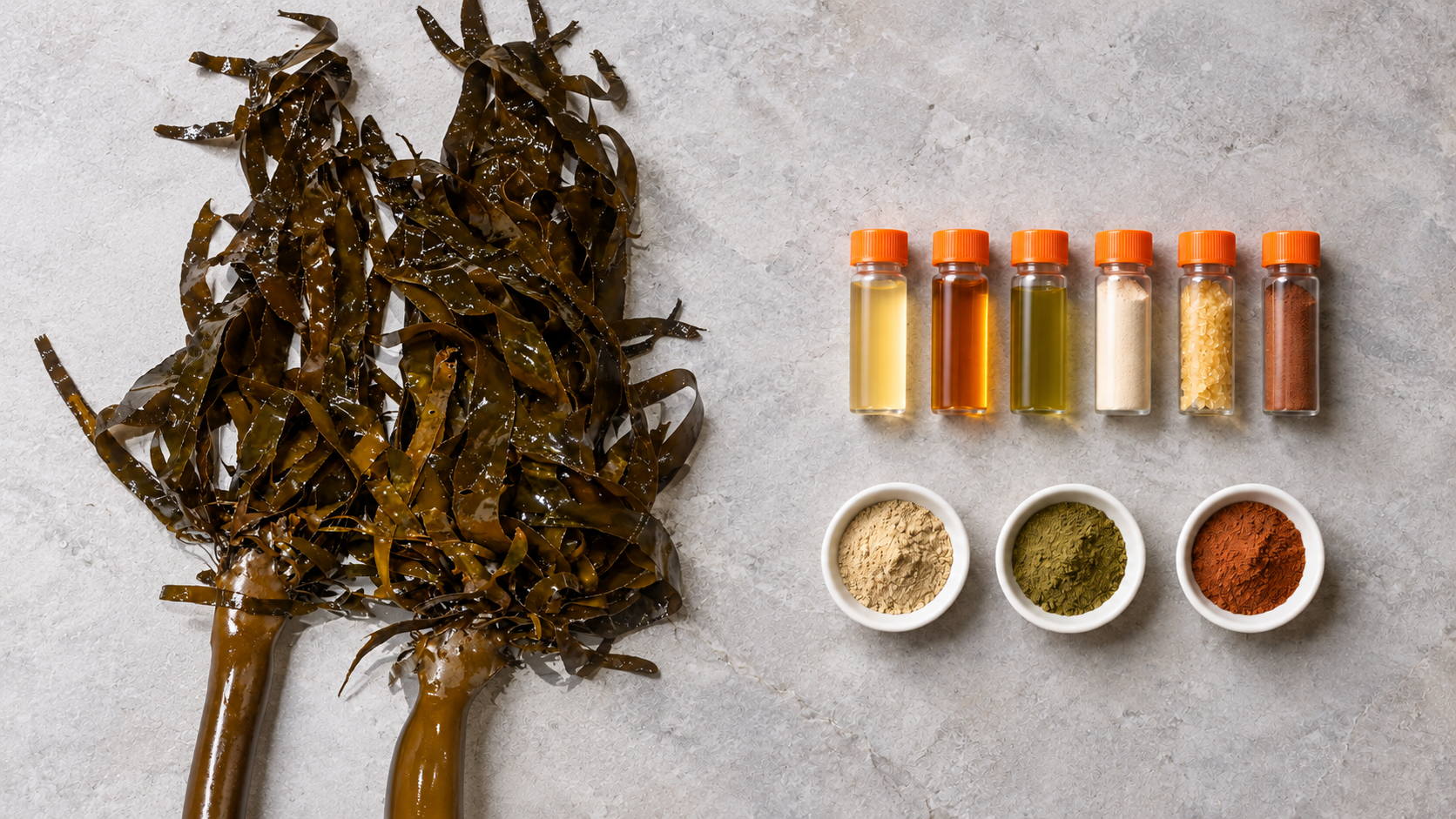
Sensory researchers have explored what happens when the key aromatic compounds in wine – esters, aldehydes and terpenes – are isolated, synthesised and blended back together in the right proportions for experienced tasters to evaluate.
The reconstituted wine smelled approximately right, but it tasted like almost nothing. Something in the interaction between those compounds – something that didn’t survive the process of taking them apart and putting them back together – was responsible for the experience. They just couldn’t identify what.
This isn’t a wine article. But it might be one of the most useful stories we know for explaining how kelp biostimulants work.
The Reductionist Habit
Modern science understandably prefers isolating things. You can’t study something you can’t separate from everything else. So when researchers began investigating why seaweed extracts produced such consistent biological responses in crops – better root systems, improved stress tolerance and stronger yields – the natural response was to ask: which compound is doing this?
Auxins were the early candidate. Kelp contains them and auxins are well known to regulate root development. It was a neat story. Except the auxin concentrations measured in commercial extracts were often too low, on their own, to explain the responses observed under practical application conditions. The effect was real, repeatable and well-documented. The explanation was incomplete.
So, researchers looked further. Phlorotannins. Polysaccharides. Betaines. Mannitol. Each has a plausible role. Each, studied in isolation, tells part of a story. None of them, on their own, necessarily tells the whole one.
What Ecklonia Maxima Actually Contains
The honest answer, after decades of research, is that we still don’t have a complete inventory of the bioactive compounds that may contribute to the biological activity of Ecklonia maxima. We know the major classes. We can identify and quantify many of them. We understand some of their individual functions reasonably well.
What we’re still mapping is the interaction network – how these compounds behave in relation to each other, how that changes when they encounter a living plant and which interactions drive the outcomes growers observe. For researchers and industry, understanding these interactions could help transform complex seaweed extracts from analytically effective products into more predictable, consistent and scientifically optimised biostimulants.
This isn’t a gap in the science so much as a feature of the biology. Ecklonia maxima has spent a very long time evolving in the cold, turbulent waters of the southern Atlantic – under wave pressure, fluctuating light and seasonal temperature swings, grazing from sea urchins and abalone. The biochemical complexity it developed isn’t accidental. It’s the accumulated result of that environment. The kelp wasn’t optimising for our analytical instruments. It was optimising for survival.
Why This Matters for How We Make the Product
If the value of fresh Ecklonia maxima extract lies in its complexity – in the relationships between compounds rather than the presence of any single one – then a responsible producer’s job is to preserve that complexity as far as processing technology allows.
Aggressive extraction methods that use heat or chemical solvents don’t just capture bioactives. They also disrupt the matrix those bioactives live in, changing molecular structures, fragmenting polysaccharides and altering the relationships between compounds. You may end up with impressive numbers for individual constituents, but a product that behaves differently in the field than a less-processed, less-interfered-with alternative.
At Karma Kelp, we use cold mechanical processing for exactly this reason. The objective is not to concentrate specific compounds, but to extract the kelp with as little unnecessary processing as possible, preserving its natural chemical and biological complexity while producing a consistent product that can be applied reliably in agriculture. The wine analogy holds. You can’t improve on the vineyard by reassembling it from its parts in a laboratory. You can only try not to ruin what the terroir built.
The Right Kind of Humility
There’s a version of this story that treats scientific uncertainty as a reason to distrust kelp biostimulants altogether. That would be the wrong conclusion.
Decades of field research on Ecklonia maxima extracts have documented consistent, meaningful results – in root development, chlorophyll content, stress responses and yield-related traits – across a wide range of crops and conditions. The uncertainty isn’t about whether the effects are real. It’s about the full mechanistic explanation for why.
That distinction matters. Growers have used seaweed on crops successfully for centuries, long before anyone could explain the biochemistry. The explanation has been catching up ever since. It just hasn’t arrived at a simple one-compound-does-this story, because the biology is more complex than that.
The most commercially honest position is to acknowledge what we know, be transparent about what we’re still learning and let the field results speak for themselves.
Which is what our ongoing trials programme is designed to do. The most credible position is to handle the results carefully.
Image Credit: Image Generator (Prompted & Reviewed by Karma Kelp)