



The Valuable Reason Seaweed Thrives in the Dynamic Benguela Current
Kelp species are growing in temperate coastal waters on almost every continent. Several of them are used commercially. A handful have been studied for biostimulant applications. But the species that has accumulated the most documented evidence for agricultural use isn’t the most widely distributed, or the easiest to source at scale.
Ecklonia maxima grows in one of the most physically demanding marine environments on the planet – and that environment isn’t incidental to what it produces.
The System that Shapes the Seaweed
The Benguela Current runs north-westward along Africa’s south-western coastline, from Cape Agulhas up through Namibia. What makes it unusual among the world’s major ocean currents is its upwelling mechanism: persistent southeasterly winds push surface water offshore, drawing cold, nutrient-dense water up from depths of 200 to 300 metres to replace it.
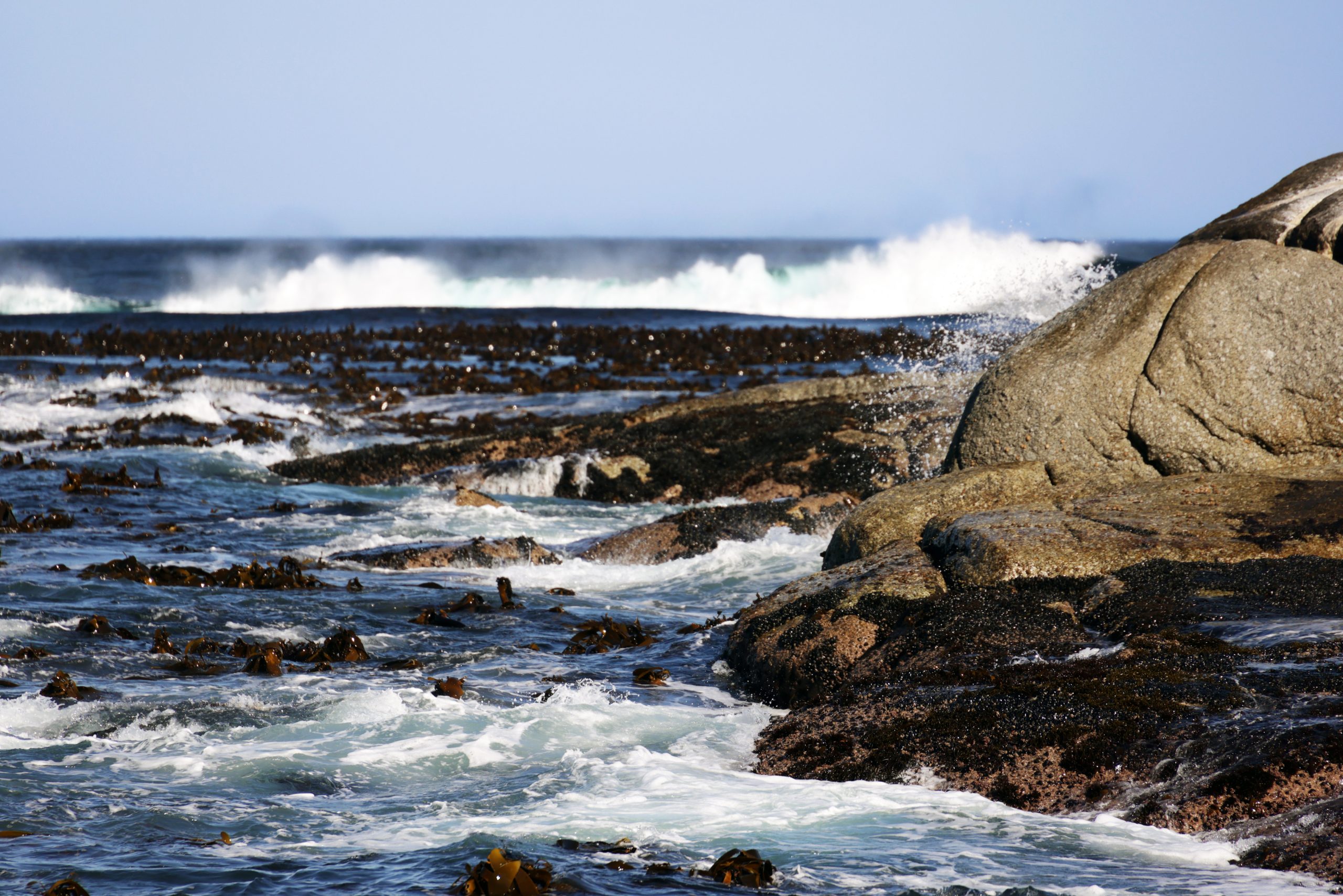
The result is surface water that’s exceptionally cold, exceptionally productive and exceptionally variable. Pulses of upwelling bring different water masses to the surface at irregular intervals, creating conditions that shift in temperature, nutrient concentration and light availability with a frequency that few marine environments experience. Kelp forests thrive at the coastal fringe of this system, growing at rates that rank among the fastest of any organism in the ocean – made possible by the nutrient concentrations the upwelling provides.
But nutrients and cold water alone don’t explain the biochemical profile of Ecklonia maxima. The physical forces acting on the kelp – constant wave energy, water movement and environmental fluctuation – are equally important in shaping its physiology.
Stress as a Biochemical Signal
There’s well-established science behind the idea that environmental stress drives secondary metabolite production in seaweeds. Brown seaweeds, in particular, respond to abiotic stressors – wave energy, fluctuating light intensity, physical abrasion and grazing pressure – by ramping up production of phenolic compounds, including phlorotannins, antioxidant pigments, osmoprotective molecules (such as mannitol) and structurally important polysaccharides. These aren’t waste products. They’re functional responses: the seaweed building chemical tools to manage the challenges its environment presents.
Research across multiple brown seaweed species has shown that phlorotannin content isn’t fixed – it varies significantly depending on where and how a plant grows, as well as the conditions under which it grows. Seaweeds from higher-stress environments consistently show higher concentrations of these compounds. The biochemical profile of a kelp from sheltered, warm, nutrient-stable water is simply different from that of one grown under constant physical pressure in cold, variable, nutrient-rich conditions. The Benguela provides all of the second kind of conditions continuously.
What this Means for Biostimulant Applications
The compounds that drive Ecklonia maxima’s well-documented biostimulant effects – phlorotannins including eckol, polysaccharides and auxin-like compounds – aren’t simply present because Ecklonia maxima is a brown seaweed. They’re present in the concentrations and structural forms they occupy because of what the Benguela demands of the plant.
There’s an important parallel here with how we think about crops. A plant that’s experienced appropriate stress at the right growth stage often produces better quality fruit, more complex flavour compounds and stronger structural tissue. The plant adapts. Its chemistry reflects its history. The same principle applies in the ocean. Studies on Ecklonia maximaextracts have reported valuable effects across a range of crops, including improved root architecture, enhanced water-use efficiency, better stress tolerance and yield improvements in vegetables, small fruits and viticulture. Research on Cabernet Sauvignon in particular found that Ecklonia maxima extract improved water-use efficiency and primary and secondary metabolite profiles in the fruit – a result with direct commercial relevance for growers navigating water constraints. These outcomes aren’t produced by generic seaweed chemistry. They’re produced by a specific biochemical profile, shaped by a specific environment.
Why Geography Can't Be Replicated
The seaweed biostimulant industry draws raw material from coastlines across the Northern Hemisphere – Norway, Iceland, the British Isles, Canada and Chile. These are legitimate sources for genuine products. But those species are shaped by different environments that produce different biochemical outputs.
The Benguela system isn’t the only demanding marine environment. But it’s one of the most intensively upwelling and it’s the exclusive habitat of Ecklonia maxima. The species is endemic – it grows nowhere else. That’s not a marketing claim. It’s a biological fact with practical implications: if you want Ecklonia maxima, it comes from South Africa’s coastal waters. The conditions that created its biochemical profile are built into where it lives.
This also explains why cultivation doesn’t solve the problem the same way it might for other seaweed species. The Benguela’s combination of cold water, intense upwelling, wave energy and fluctuating conditions isn’t a set of parameters you can dial into a tank. A plant grown under controlled and relatively stable conditions is unlikely to experience the same combination of environmental pressures found in the Benguela ecosystem. As a result, differences in biochemical composition should be expected, even when the species is the same. Geography does more than determine whereEcklonia maxima can be found. It helps determine the environmental pressures that shape the seaweed’s chemistry. For a species whose agricultural value is linked to that chemistry, origin isn’t simply a sourcing detail – it’s part of the biological story of the product itself.
The Compound Effect of Environment and Origin
Species choice matters in biostimulant selection. Processing method matters. Raw material freshness matters – as discussed in our previous article. But before any of those decisions are made, the environment that grew the raw material has already done much of the work.
In the case of Ecklonia maxima, that work was done by one of the most productive and demanding ocean systems on Earth. The biochemical complexity growers benefit from wasn’t designed in a laboratory or optimised in a production process. It was built, over the plant’s lifetime, in response to what the Benguela asked of it. Different environments produce different seaweeds. That’s not a judgement – it’s biology.
Photo Credit: Magda Ehlers (pexels.com)