


Why Kelp Biostimulants Work Best Before Plants are Under Pressure
There’s a common assumption built into how many growers use biostimulants: apply when the plant needs help. A dry spell hits, nutrient uptake drops, growth stalls – reach for the bottle.
The science suggests a different approach. And understanding why changes not just when you apply, but what you can reasonably expect.
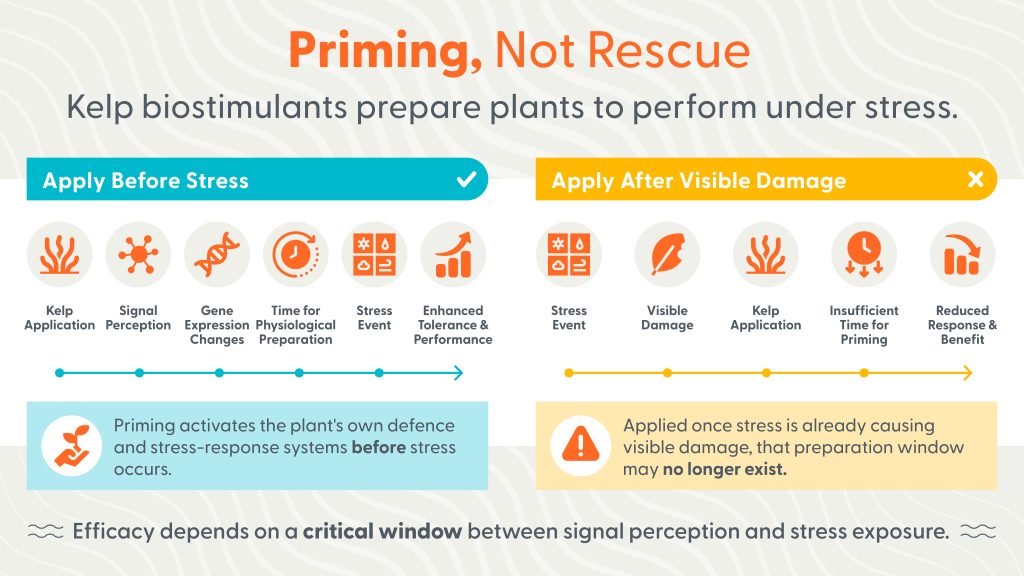
Priming, Not Rescue
Kelp biostimulants don’t work the way a fertiliser or a fungicide works. They don’t supply a missing nutrient or eliminate a threat directly. What the research consistently shows is that seaweed extracts interact with plant signalling pathways – influencing how a plant prepares for and responds to stress, rather than correcting a problem after it’s taken hold.
This mechanism is described in plant physiology as priming. A primed plant isn’t actively fighting stress – it’s in a state of readiness. Its defence and stress-response pathways are upregulated in anticipation of a challenge. When that challenge arrives, the response is faster and more effective than it would be in an unprimed plant.
Research on seaweed extract application has documented this priming effect across a range of crops and stress types – drought, salinity, heat and pathogen pressure. In each case, the consistent finding is that plants treated before the stress event show meaningfully better outcomes than those treated during or after it. The plant needs time to translate the biochemical signal into a prepared physiological state. When applied after stress is already causing visible damage, that preparation window may no longer exist.
The Energy Trade-Off
There’s a related reason why timing matters, rooted in how plants allocate resources. When a plant is under active stress, the majority of its metabolic energy is diverted to managing that stress – maintaining membrane integrity, producing protective compounds and managing water balance. Growth, development and quality-building processes take a back seat.
Applying a biostimulant to a plant already in this state asks it to do two things simultaneously: manage the crisis it’s in and process a new biochemical signal. The plant’s capacity to respond to that signal is reduced precisely when the stress is most acute.
Applying before stress arrives allows the plant to perceive and respond to the biostimulant signal before its resources become heavily committed to stress management. The plant can process the biostimulant’s signals while still allocating resources to growth, arriving at the stress event in a stronger position and improving the likelihood of maintaining growth, yield and quality under pressure. What this Looks Like in Practice
The priming principle applies broadly, but application timing aligns most clearly with defined crop growth stages. Two examples from the research illustrate it well.
In tomatoes, studies on Ecklonia maxima extract applied at transplanting and in the early vegetative stage showed improvements in seedling quality, root development and shoot growth. The transplant moment is one of the highest-stress points in the crop cycle – root disturbance, environmental change and establishment pressure all arrive simultaneously. Applied at or just before transplanting, the biostimulant supports root establishment during the window when that process is most active and most responsive. Applied two weeks into a stressed, struggling transplant, the same product has a narrower opportunity to contribute.
In blueberries, research using Ecklonia maxima extract applied across three phenological stages – full bloom, early green fruit and fruit colouring – documented improvements in yield and fruit quality. The timing here is instructive: applications began at full bloom, before the metabolic demands of fruit development peak, priming the plant’s partitioning and stress-tolerance systems ahead of the most resource-intensive phase of the season. Growers who applied at earlier stages consistently captured a greater share of the available benefit. The pattern holds across species. Whether it’s root establishment, flowering, early fruit set or a predicted dry period, the consistent principle is the same: get in before the demand hits.
Frequency and the Priming Window
A single application rarely captures the full benefit available. Priming responses have a duration – they don’t persist indefinitely and the plant’s readiness state diminishes over time as the initial biochemical signal fades. Strategically timed applications can help maintain or reinforce that state of preparation through key periods of crop development and stress risk. This doesn’t mean constant application. It means thinking ahead about which growth stages carry the highest stress risk and scheduling applications to arrive before each of those windows – not during them. For most crops, that’s a rhythm of two to four applications per season, timed to anticipate rather than react.
The Expectation Problem
Some growers try biostimulants once, during a stress event, see a limited response and conclude the product doesn’t work. That conclusion may be unfair to the product and unhelpful to the operation.
A kelp biostimulant applied to a plant already experiencing drought stress, late in fruit development, in a single application, is being asked to perform outside its mechanism of action. The absence of a dramatic rescue response isn’t evidence of inefficacy – it’s evidence of the wrong application strategy.
The growers who consistently report the strongest results from seaweed biostimulants are those who integrate them into a seasonal programme built around anticipation. The product doesn’t change. The approach does.
Used at the right time – before the plant needs it – kelp biostimulants do what the science says they do. Used as an emergency intervention, the science predicts a different outcome. Both results are real. Only one represents the product being used correctly.
Photo Credit: @Aleksandarlittlewolf (magnific.com)